
This blog post is by Abigail McCall, the Coordinator of the International Network for Public Restaurants.
The first public restaurant* I ever saw was in Diyarbakır (Amed), Türkiye. I was at the Scottish National Party conference with a thousand copies of the policy proposal for Public Diners hoping to catch the attention of politicians who, like the proposal said, might think this was “an idea whose time has come.” Half an hour in, Uğur walked up to the stall and confirmed the idea had come – to his hometown one day ago. He showed me his phone and there it was: “Halk Lokantası” (folk’s/people’s restaurant) opened in the Kurdish region of Türkiye – a real life public restaurant.
Two years later, I’ve eaten lunch at that public restaurant and seven others across the country. Türkiye now has over 50 public restaurants and more are opening every day. This is big. Most of the world is used to public infrastructure for other aspects of wellbeing – public healthcare, public transport, public education – but not for food. We certainly don’t know and want public restaurants across the world, like we do public healthcare. Not yet, at least.
What started as a proposal from the main opposition party (CHP) in Istanbul has spread to all corners of the country and to three of the mainstream parties. Each party has given their public restaurant scheme a different name: CHP has Kent Lokantası meaning “city restaurants”; the Kurdish party, DEM, has Halk Lokantası and now, the country’s governing party, originally sceptical of this policy in Istanbul, has Millet Lokantası meaning “nation’s restaurant”. This summer I ate at all three – from one on the Bosphorus to one on the Tigris – this is what I found out.
26, student and travelling across Türkiye
I’m a student in Barcelona. I’m 26 and it’s summer break. It’s too expensive to fly home (Australia) so I decide to go to the homes of my roommates. It’s a win-win for me: I get local knowledge and free accommodation. The second is especially important. I’m putting myself through school and whilst my part time work covers the necessities – there’s not a lot left for this kind of fun. So I know I need to be strategic. My first stops in Sicily and Crete spook me a little. I go over the daily budgets I set for myself and I’m heading straight into Istanbul inflation.
Istanbul, kent lokantası
If it wasn’t for public restaurants I either would have had to drink a lot less coffee and had a lot less fun, or cut my trip short. Thanks to the network of kent lokantası (over 30) across this mega city, I could eat lunch for €2 (100TL). That left me with enough to eat a simit on the street for breakfast (30TL), try some specialty dishes at historic places recommended by Anthony Bourdain and Chef’s Table (at least 600TL), get a fish sandwich when I’m by the water (200TL) and say yes to every tea (80TL) and coffee (150TL) that was offered to me. I ate at one kent lokantası next to a university with students and police officers; another near the Hagia Sophia with tourists, construction workers and retirees. I crossed the Bosphorus with my public transport card (Istanbulkart) and I used that card to pay with a discount (90TL instead of 100TL) for my lunch of eggplant kebab, bulgur pilavı, mercimek çorba (a fantastic lentil soup), bread and ayran. I think to myself: I’m getting home cooked food in a city I don’t have a home in. Wow. On the bus home, I do a double take: is that a kent lokantası on wheels? Yes, my friend says – it travels around the neighbourhood of Şişli. When the mayor of this municipality was replaced by a kayyum (trustee) it closed – but only for 12 days. People protested immediately. They made their favourite dishes out the front and got people to repeatedly call the municipality asking: when will our public restaurant be back open? The municipality had no choice but to get it back on the road.
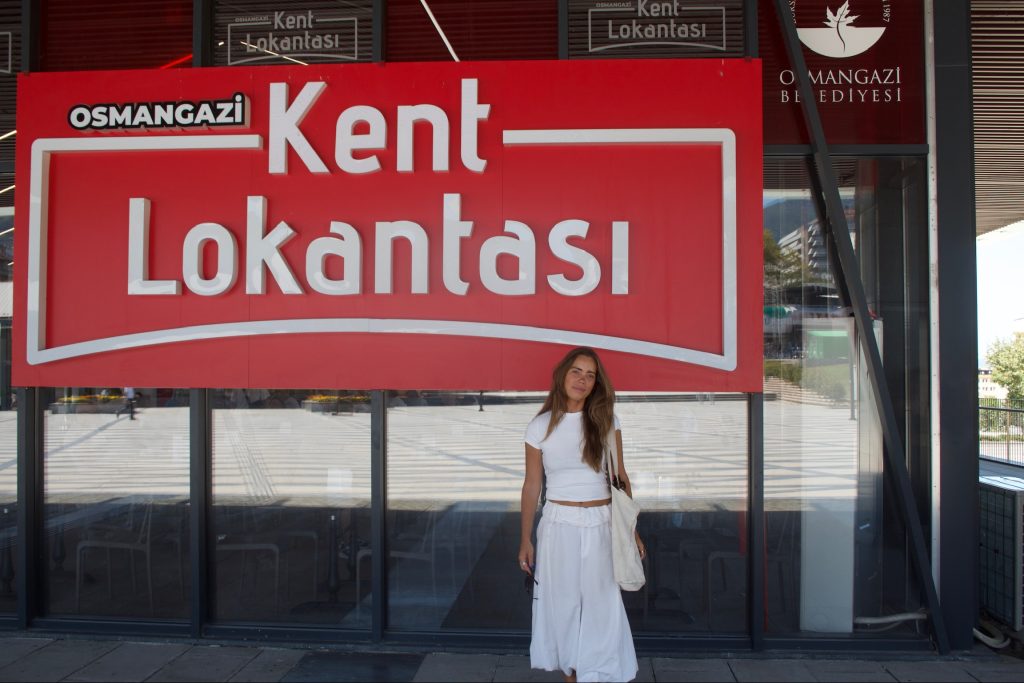
Bursa, kent lokantası
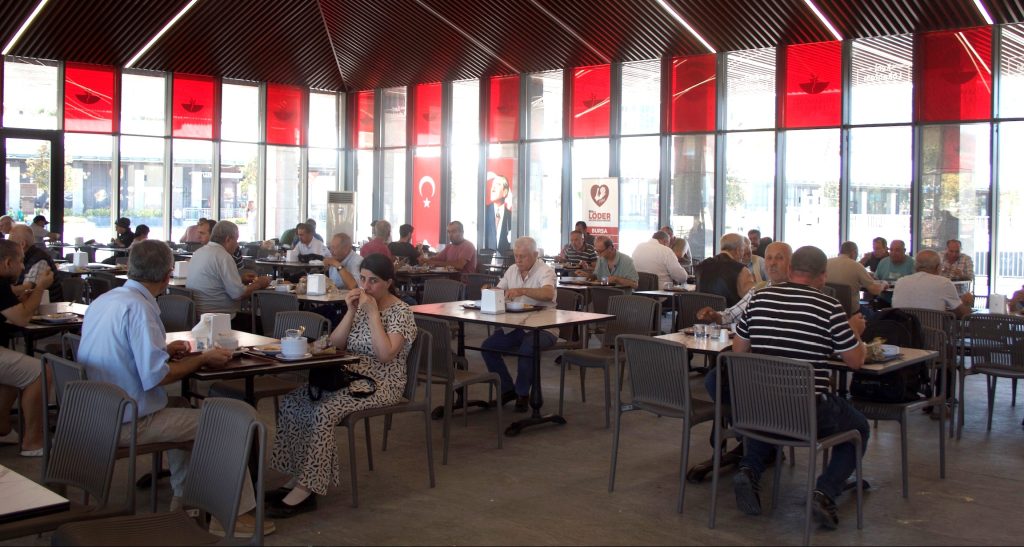
The parents of the roommate who I followed into Türkiye live in Bursa – the country’s fourth largest city two hours south of Istanbul. It is also governed by CHP and has three kent lokantası: one in a big park, one in a shopping centre and one in a neighbourhood. But the first bit of public food I had in Bursa was not at one of these restaurants – it was at the public ice cream stand. On the sickly hot day that it was, I got a cold scoop for 30TL (others are 50TL here and at least 100TL in Istanbul). Everyone was walking around as if everything was normal. I wanted to shake them and say: “look, it’s public ice cream! do you realise how radical this is!” Afterwards I crossed the park to the kent lokantası. It used to be a venue for weddings, complete with chandeliers and round tables. I got to try kuru fasulye – a tomatoey beany dish my friend had made for me in Barcelona and now my first public vegetarian meal! I see groups of people my age at this one and I meet Gülsüm in the line after she points out a minuscule piece of lint on my shirt and strikes up a conversation.
Diyarbakır/Amed, halk lokantası
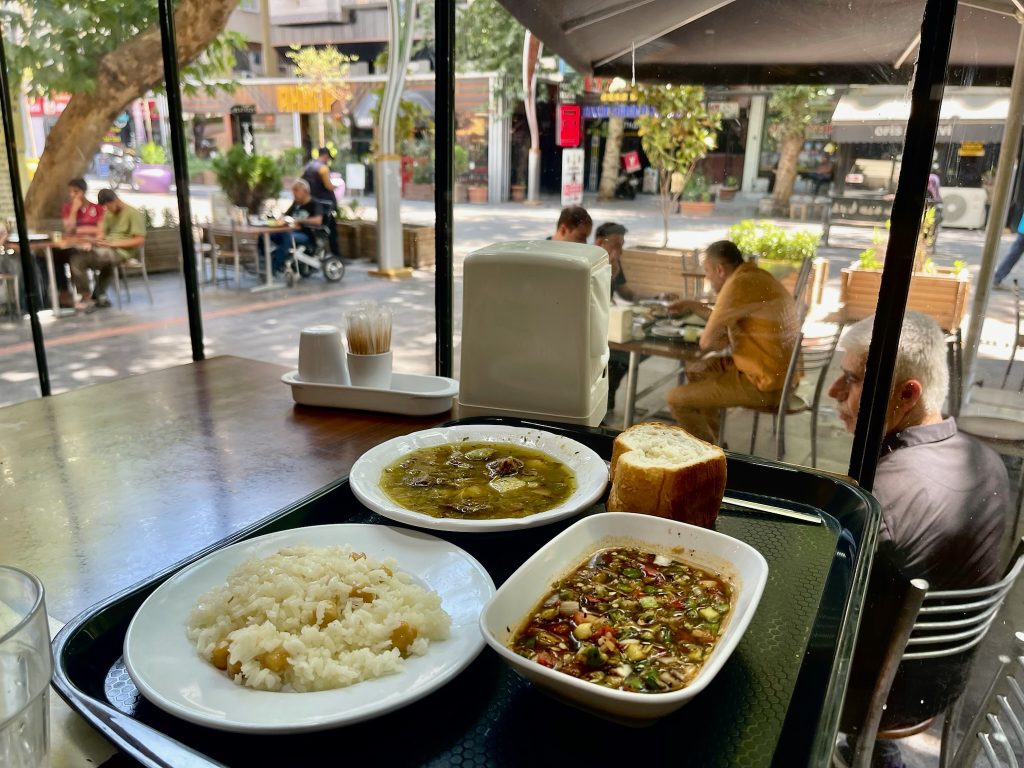
My friend is Kurdish. She was born in a town called Siverek, one hour from Diyarbakır – the unofficial capital of the Kurdish region. After Bursa, we drive 13 hours east across the country until we reach Diyarbakır on the banks of the Tigris. And sure enough, there in the heart of old Mesopotamia, the birthplace of farming, inside some of the oldest walls in the world, I see my public restaurant. I think: it’s not a dream. It’s yellow, it’s beautiful and it exists. It’s all been real. And the waiter is cute. I eat my first public salad with a main dish that loosely translates to “forest stew” filled with colourful vegetables and smaller amounts of slow cooked kebab meat. It comes with public bread (yes, there are public bakeries here as there are in Bursa and Istanbul too). It’s warm and it comes in hunks. Mine is almost shaped like a heart (see picture as proof). There’s a constant stream of people coming in: shoppers taking a break, kids (it’s school holidays), supermarket store workers, the guy who works at the coffee shop across the road. There are polished boots, steel cap boots and comfortable slides; uniforms, suits and ironic t-shirts. I think: yeah, this is the folk’s restaurant. One day, I eat with members of the DEM party who are responsible for running the restaurants. They tell me it’s ironic but not an accident that the southeast region of Türkiye is one of the most fertile and yet has some of the most barriers to accessing and affording good food. The right to food, like many other rights, has been denied by political decisions. Securing it is not only necessary for making life liveable but for hopefully, eventually, making freedom more real here. Public restaurants are one of the ways they are starting to do this.
Siverek, millet lokantası
I thought my public restaurants summer ended in Diyarbakır with the halk lokantası. But it didn’t. When we finally arrived to my friend’s hometown, I told her uncle what I had been doing. “We have them too!” he said. Are you sure? I replied. Siverek is an AK Party governed municipality and I thought the party position was that these were a waste of money. Yes I’m sure, he said, but they’ve called them millet lokantası “nation’s restaurants.” He was right – there are public restaurants in Siverek and they’re delicious. In fact, I had my best meal here: köfte, salad, a local dessert and, if you wished, made to order lahmacum loaded with an amount of herbs that would easily cost me over €3 in Barcelona. Surrounded by DEM municipalities where halk lokantası are multiplying, it seems the people of Siverek simply asked: “where is ours?”
Reflections
My main thought after all these lunches is: it’s working. By working I mean public restaurants are not a party project anymore, they are an expectation of the people. By working, I mean they are already fixed parts of the city’s streets and the people’s weeks. They are spreading throughout the country and across all party lines, not as pop ups but as public infrastructure. In these municipalities, people get their rubbish collected, children educated, blood tested, bus to work and now their lunch. I believe each party would lose votes not only if they don’t run their public restaurants well, but also if they decide not to open one in their municipality.
To be clear, I don’t think public restaurants can solve Türkiye’s food problems. They won’t fix the toxic combination of rising inflation and inequality that the country is facing. But they are a necessary part on the way to better. I believe people have felt how governments can act on protecting their right to food via these restaurants – and they won’t let any party walk back on it.
This ubiquity and permanence brings a new set of challenges. Introducing a public restaurant doesn’t automatically help deliver the right to food, or necessarily protect other rights. Public restaurants are a serious next step in the history of public provision and there are serious opportunities and challenges that come with this. The policy capacity of public restaurants to serve people’s rights must not be hijacked by their capacity to surveil or dictate people’s lives. I know I enjoyed eating at some public restaurants a bit more than my friend did. There were some rooms where I felt control – two hands on the wheel driving my tray along the canteen line – whilst she felt conform – arms locked in place trying to remember the steps.
Still, I can say, things felt freer and summer was better because we could eat lunch in the city. I had more time, money and energy to spend in the places we were visiting and the people we were with. In Istanbul, Bursa, Diyarbakır and Siverek I was really there, full and happy, certain that this was happening and excited to be part of it.
*public restaurant = a restaurant that operates with some form of permanent state support and is universal (i.e. open to everyone/general public).